Testing a Sex AI Companion Before Committing
A trial works better with a deadline and a scorecard than with a feeling. Give it fourteen days, four criteria and a written log, and the decision at the end takes five minutes. For scale: four sessions a week over those two weeks is eight sessions, which at half an hour each is four hours of evidence, and that is enough to judge continuity, tone control, resumption cost and discovery speed.

Key takeaways
- Fix the window first: fourteen days and eight planned sessions beats an open-ended trial that never ends.
- Score four things only — continuity, tone control, resumption cost and discovery speed — so the log stays short.
- Record figures as you go: messages sent, sessions run and characters saved. Forty messages a day is 280 in a week.
- Crushon describes Sex AI companions as adapting to your personality and remembering your preferences, which is exactly what the continuity test is designed to probe.
Define the window before the first session
The failure mode of a trial is that it has no end. Without a deadline, every disappointing session is excused and every good one is treated as proof, and three months later the question is still open. Two weeks is long enough to cover a working week and a weekend, and short enough that the decision arrives while the evidence is fresh.
Then decide how often you will test. Four sessions a week is a reasonable minimum, because it produces two sessions on the same character in the same week and lets you see whether continuity holds without a long gap. Eight sessions in total gives you two sessions per criterion, which is enough to distinguish a pattern from an accident.
Write the plan down before you start: the window, the session count and the four things you will score. A plan written in advance is harder to bend at the end, which is the whole point of having one.
Four criteria, and how to test each
Continuity is the first test, because it decides whether a long-term companion is possible at all. Return to the same character after a gap of three or four days and check whether the scene resumes without a full recap. Tone control is the second: send one correction and see whether the next two replies hold the new register.
Resumption cost is the third, and it is the most practical. If picking a scene back up takes ten minutes of re-reading, the character is expensive to keep. Discovery speed is the fourth: how many genuinely new characters did you find and keep during the fortnight? A trial that produces no new saves has answered the discovery question in the negative.
| Criterion | How to test it | Pass condition | Figure to log |
|---|---|---|---|
| Continuity | Return after three or four days without a recap | The scene resumes on one orienting line | Days between sessions |
| Tone control | Send one correction, then observe two replies | Both replies hold the corrected register | Corrections per session |
| Resumption cost | Time how long it takes to restart a scene | Under two minutes of reading back | Minutes to restart |
| Discovery speed | Count new characters found and kept | At least one new save a week | Characters saved |
| Session habit | Record length of each of the eight sessions | At least half reach a completed beat | Sessions and minutes |
Worked example: a fourteen-day log, added up
Assume an illustrative trial of eight sessions across fourteen days, each running 30 minutes. Eight sessions times 30 minutes is 240 minutes, so four hours of testing. If the reader sends 40 messages a day, the fortnight contains roughly 560 messages, which is 40 times 14. For context, the same daily rate across a 30-day month is 1,200 messages.
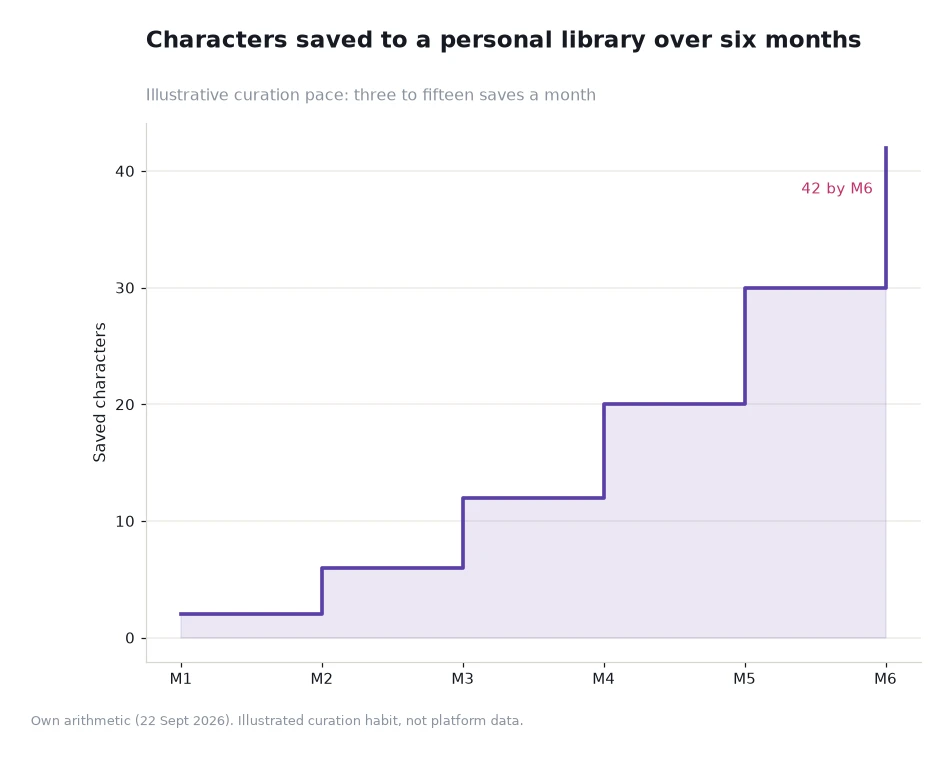
Now add the saves. If week one produces three kept characters and week two produces five, the trial ends with eight saves, which is four a week. If that rate held and then grew at an illustrative two extra saves a month, a six-month total would look like 2, 6, 12, 20, 30 and 42 kept characters — the curve shown in the chart below. Those figures are an illustrated habit rather than platform data.
The useful output of the log is not the totals but the ratios. Four hours of testing that produces eight saves is one kept character per 30 minutes of use. That is the number to compare against a later fortnight, because it measures whether the discovery process is getting faster or slower.
What to do at the end of the window
Read the log rather than your memory of the fortnight. Continuity either held on one orienting line or it did not; corrections either settled after one message or they kept coming. Those are answers, and two of them failing is a reason to walk away regardless of how much you enjoyed a single good session.
If the trial passes, decide what you are committing to — a habit, a saving routine and a shortlist of characters, not a subscription to a feeling. The https://crushon.ai/ai-sex-chat page is a fair place to read what the service itself claims about adaptation and memory, and to check your own findings against the platform's description.
If it fails, note which criterion failed and retest in a month with a different pair of characters. Most failed trials are failed character choices rather than failed platforms, and a second fortnight with a better-matched entry is a cheaper experiment than a longer commitment to the wrong one. When discovery is the criterion that failed, start the retest from the character search page rather than the front page, and work from the trending tag list.
It also helps to compare your findings with the platform's own material rather than with other trials. The tutorials on the AI chat blog describe how the service expects readers to use it, and reading them beside your log is a quick way to spot a test that was set up badly from the start.
A third outcome is also common: three criteria pass and one is marginal. In that case extend by one week only, test the marginal criterion in isolation, and decide. Endless extension is what the window was designed to prevent, and a single additional week is enough to settle a marginal question without turning the trial into a lifestyle.
Frequently asked questions
How long should the trial be?
Fourteen days covers a working week and a weekend. Shorter does not produce two observations per criterion, and longer tends to turn into indefinite use.
What if I like one character immediately?
Keep the log running. One strong character answers the continuity question for that entry but says nothing about discovery, which is the criterion most trials fail.
Should I test more than one character per session?
Test at most two, and keep the rest of the fortnight for repeats. Testing ten characters once each measures first impressions, not the continuity you are trying to evaluate.
Write the plan, run the fortnight, decide once
Put the window and the four criteria in a note before your first session, and add a line after each one. At the end, read the lines and make a single decision rather than a rolling series of small ones.
The discipline is the point. A timed test with a scorecard converts a vague sense of whether something is worth your time into an answer you can act on, and it takes a fortnight — which is a small price for not spending six months uncertain.
Data and sources: the platform's own description of adaptive replies, remembered preferences, roleplay and a private and secure environment, read on 22 Sept 2026, together with the service's FAQ on restrictions and realism. Session, message and save figures are worked examples, not platform measurements. This article is written for adults 18+; read 22 Sept 2026.