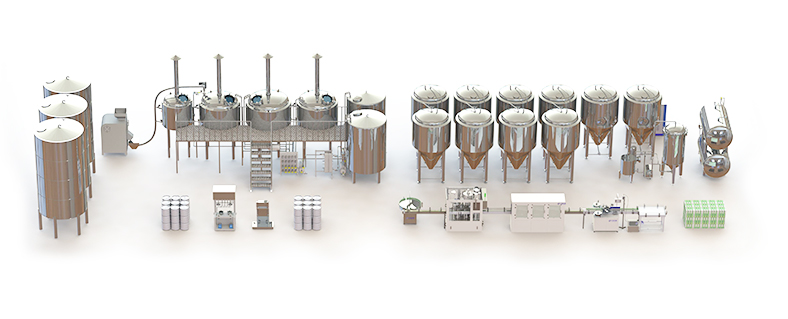
A turn-key brewery package normally covers malt handling, milling, brewhouse vessels, wort cooling, fermentation tanks, bright beer tanks, glycol refrigeration, CIP equipment, water treatment, process piping, controls, and packaging. A 10–20 hL brewhouse may use 20–40 hL fermenters when two brews fill one tank, while commercial fermentation commonly occupies 7–21 days depending on yeast, temperature, and beer style. Refrigeration must handle fermentation heat plus crash cooling, often taking beer from about 18–22°C to 0–4°C. The equipment list only works when brewhouse output, cellar volume, utilities, cleaning capacity, and packaging speed are sized around the same production plan.
A turn-key system usually starts before wort enters the brewhouse. Malt handling can include a roller mill, hopper, grist case, weighing equipment, screw conveyor, flexible auger, or bucket elevator. A brewery producing 2,000–5,000 hL per year may still use manual bag loading, while larger plants often move toward bulk silos and automated conveying to reduce handling time.
Mill selection affects the next production step because particle size changes how water moves through the grain bed. Two-roller and four-roller mills are common in craft and regional breweries, and many systems are designed to keep most husk material relatively intact while breaking the endosperm into smaller particles.
That milling result matters when the mash reaches the lauter tun. A typical brewhouse may use 2, 3, or 4 vessels, with functions divided among mash mixing, lautering, boiling, and whirlpool separation. A two-vessel system saves floor space, while a four-vessel system allows more process overlap.
For example, a 20 hL system producing 3 brews per day can theoretically send about 60 hL of wort to the cellar before losses. Real finished-beer volume will be lower because grain absorption, trub removal, yeast sediment, transfers, filtration, and packaging each remove product.
A brewery should therefore compare “20 hL brewhouse capacity” with actual cold-side output per brew. A nominal 20 hL vessel does not automatically produce 20 hL of packaged beer.
Brewhouse heating can be steam, direct electric, or another engineered heat source. Steam systems are widely used when faster heating and repeated daily cycles are required, while electric heating is often practical in smaller installations where sufficient electrical service is already available.
Boiling typically lasts around 60–90 minutes in many brewing programs, although recipes vary. Evaporation rate may be roughly 4–10% per hour depending on kettle geometry, heat input, altitude, and operating practice, so kettle sizing needs adequate freeboard above the normal wort level.
After boiling, the whirlpool separates much of the hop and protein material before wort cooling. Wort can leave the whirlpool close to boiling temperature and must usually reach approximately 8–14°C for many lager fermentations or 16–22°C for many ale fermentations.
A plate heat exchanger normally handles that temperature drop. Single-stage systems may rely on cold brewing water, while two-stage systems can add glycol or chilled water when incoming water is too warm to reach pitching temperature in one pass.
| Equipment area | Typical design reference | Why sizing matters |
|---|---|---|
| Brewhouse | 5–100+ hL per brew | Sets hot-side batch volume |
| Fermenter | 1×, 2×, or more of brew size | Determines brews per tank |
| Fermentation period | about 7–21 days | Controls cellar turnover |
| Bright tank | often 1–2 brew volumes | Buffers packaging |
| Wort cooling | often 30–90 minutes per batch | Affects brewhouse cycle time |
| Crash cooling | roughly 18–22°C down to 0–4°C | Determines refrigeration demand |
Cooling becomes more demanding once several fermenters operate at the same time. Yeast generates heat during active fermentation, and the glycol system must also support cold conditioning, crash cooling, bright tanks, and sometimes packaging or cold-storage equipment.
A 2020s commercial brewery is commonly designed with a glycol chiller, reservoir, circulation pumps, insulated supply and return lines, solenoid or modulating valves, and individual tank temperature controls. Chiller selection should use peak simultaneous cooling demand rather than the total number of tanks alone.
A cellar with ten fermenters may, for example, have three tanks actively fermenting, one tank being crash-cooled, and six tanks holding finished beer at low temperature. Crash cooling usually demands much more refrigeration over a short period than simply maintaining a tank at 2°C.
Fermentation capacity often limits annual output before brewhouse volume does. A 10 hL brewhouse feeding five 20 hL fermenters has a different production ceiling from the same brewhouse feeding twelve 20 hL fermenters, even though the hot-side equipment is identical.
Fermentation vessels are commonly stainless-steel cylindroconical tanks with cooling jackets, insulation, pressure fittings, temperature probes, sampling valves, CIP spray devices, and yeast or product outlets. Many commercial tanks operate as unitanks, allowing fermentation, conditioning, carbonation, and sometimes serving from the same vessel.
Pressure ratings vary by manufacturer and market, so they need to match the intended process and applicable vessel standards. Some breweries ferment close to atmospheric pressure and apply pressure later, while others use controlled pressure during parts of fermentation.
Bright beer tanks add another layer between fermentation and packaging. They are commonly used for carbonation, clarification, short-term storage, and stable supply to a filler, especially where several packaging runs are scheduled from the same cellar.
A brewery can package directly from unitanks, but bright tanks may improve production flow when one packaging line serves several beers. A canning line running 30 cans per minute, for example, processes about 1,800 cans per hour before stops, changeovers, quality checks, and operator interruptions are counted.
Packaging speed therefore has to fit tank size. Filling 330 mL cans at 1,800 cans per hour moves about 594 L per hour, while 473 mL cans at the same count rate move about 851 L per hour. Faster equipment only helps when upstream tanks can supply beer continuously.
Oxygen management becomes especially important at this stage. Many breweries aim for low dissolved oxygen during transfer and packaging because oxygen can accelerate flavor and aroma changes during storage, particularly in hop-forward beer.
Keg systems have different throughput requirements. A small brewery may use a single-station washer and filler, while a production brewery may use multi-head machines that wash, purge, sanitize, and fill several kegs in sequence.
Cleaning equipment connects all of those areas. A CIP system can include separate caustic, acid, rinse-water, or recovery tanks, together with pumps, heat exchangers, dosing equipment, conductivity measurement, and automated valve control.
Caustic cleaning solutions in brewery applications are often used at concentrations around 1–2%, although the correct concentration depends on chemical supplier instructions, soil load, temperature, equipment material, and cleaning time. CIP return flow also needs enough velocity to remove soil from pipe walls and fittings.
Cleaning capacity should be checked against the production schedule. A brewery that can brew 4 batches per day but can only clean one cellar vessel at a time may lose hours between fermentation, transfer, and packaging operations.
Water treatment is selected from the actual source-water analysis. Carbon filtration can remove chlorine compounds, softeners reduce hardness, and reverse osmosis can produce lower-mineral water that brewers rebuild according to recipe requirements.
Water storage also affects scheduling. Hot liquor tanks are commonly sized to support mash-in, sparging, cleaning, and heat recovery, while cold liquor tanks can provide water for wort cooling when municipal supply temperature or flow is inconsistent.
Utilities around the process should be included in the equipment scope. Steam boilers or generators, air compressors, CO₂ distribution, electrical panels, pumps, cable trays, drainage interfaces, and ventilation connections all affect whether installed equipment can operate at its rated capacity.
For a mixed-production facility, a Brewery/Distillery/Winery All-In-One Solution may share selected stainless-steel fabrication, tanks, pumps, cooling equipment, water treatment, and controls, while fermentation, distillation, wine handling, and sanitary process requirements remain separately engineered.
Process piping deserves the same attention as tanks. Sanitary stainless-steel lines are typically used for wort, beer, CIP solution, brewing water, glycol, gas, and steam services, with routing planned around drainability, cleaning access, pressure drop, and maintenance.
Manual butterfly valves are common in smaller breweries, while larger systems may use pneumatic valves, valve manifolds, flowmeters, level sensors, and PLC-controlled transfer paths. Automation becomes more useful as the number of tanks and repeated transfers increase.
A small 10 hL brewery may operate effectively with manual valves and local temperature controllers. A 50–100 hL plant brewing several times per day may benefit from recipe control, automated water dosing, pump-speed control, valve sequencing, batch records, and centralized alarms.
The supplier scope should therefore state exactly where responsibility starts and stops. Equipment delivery may include tanks, piping, controls, installation, commissioning, and operator training, but building work, floor drains, electrical distribution, gas storage, permits, fire systems, or local utility connections may remain outside the package.
Before purchase, the production model should show brews per day, brew days per week, fermenter occupancy, average fermentation time, bright-tank use, packaging hours, and planned annual volume. A plant targeting 10,000 hL per year requires a different cellar and utility design from a 2,000 hL brewpub even when both use similar beer recipes.
The same check should cover future expansion. Leaving space for four additional fermenters is useful only when the glycol chiller, electrical service, piping headers, pumps, hot-water capacity, and packaging line can support the added volume without major replacement.
A well-specified turn-key proposal therefore lists more than vessel dimensions. It should include working volume, gross volume, material grade, surface finish, jacket area, insulation, pressure rating, motor power, pump flow, heat-exchanger duty, utility demand, control level, connection size, and installation responsibility.
When those figures are provided for every major system, buyers can compare proposals on measurable engineering terms rather than counting tanks. A lower equipment price may exclude refrigeration, CIP, automation, installation, or packaging hardware that represents a substantial part of the finished brewery cost.