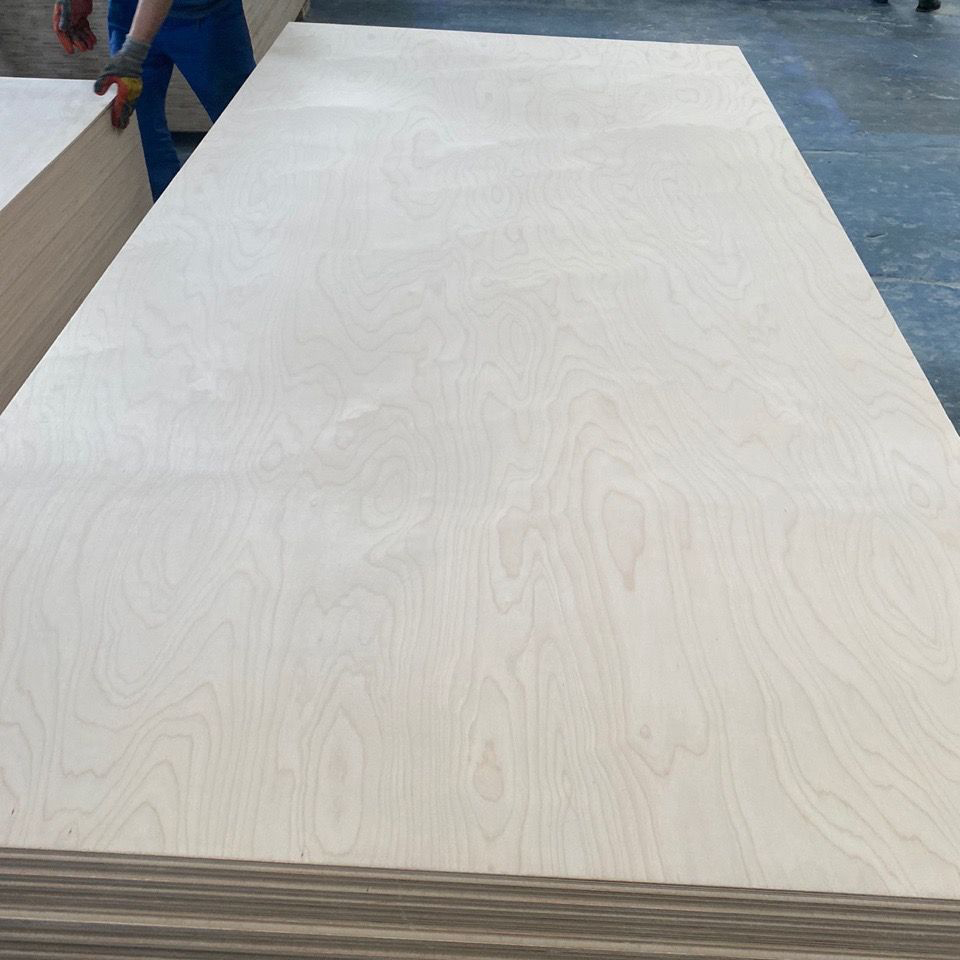
E1 Medium Density Fibreboard is MDF manufactured to meet the E1 formaldehyde emission class used for wood-based panels. Under EN 13986 criteria, E1 can correspond to a chamber concentration of no more than 0.1 ppm, or 0.124 mg/m³, after 28 days under EN 717-1 testing. MDF itself is made from refined wood fibres bonded with resin under heat and pressure, producing a smooth, uniform panel suitable for furniture, cabinets, doors and interior panels. E1 describes formaldehyde performance, not overall board quality. Density, bending strength, swelling, moisture resistance, thickness tolerance and surface quality still need separate specifications.
The structure of MDF explains why it behaves differently from plywood and particleboard. Wood is broken down into small fibres, dried, blended with adhesive and formed into a loose mat before hot pressing. Commercial boards commonly fall around 600–800 kg/m³, although density varies with thickness, product design and manufacturer. An 18 mm board can therefore have different machining performance from another 18 mm board even when both carry an E1 declaration.
Pressing creates a density profile through the panel rather than one perfectly uniform density from face to centre. Faces are normally denser because they receive heat and pressure first, while the centre is less dense. That difference matters when routing a 10 mm groove into an 18 mm cabinet door: removing the dense face exposes softer material, which can change edge smoothness, paint absorption and screw performance.
E1 classification deals with formaldehyde released from a wood-based panel under specified conditions. Under the European E1 definition referenced in EN 13986, a panel can qualify at no more than 0.1 ppm, equivalent to 0.124 mg/m³, after a 28-day EN 717-1 chamber test. Other recognized routes include limits based on EN 120 or EN 717-2, so numbers from different methods should not be placed side by side without checking units and procedures.
That distinction becomes important when material is sold into the United States. EPA TSCA Title VI sets formaldehyde emission limits of 0.11 ppm for MDF, 0.13 ppm for thin MDF and 0.09 ppm for particleboard; hardwood plywood covered by the rule is limited to 0.05 ppm. EPA defines thin MDF as MDF with a thickness of 8 mm or less.
| Property | Typical point to check | Why buyers check it |
|---|---|---|
| Formaldehyde class | E1 under stated test method | Indoor emission requirement |
| Density | Often about 600–800 kg/m³ | Machining, weight and fastening |
| Thickness | Commonly 3–30+ mm | Component design and machining |
| Moisture content | Supplier specification required | Storage and dimensional behavior |
| Thickness swelling | Test value required | Suitability around humidity |
| Internal bond | Test value required | Integrity through panel thickness |
| Bending properties | Test value required | Shelf and furniture performance |
An E1 mark alone therefore cannot tell a furniture factory whether a shelf will sag, a screw will hold, or a routed profile will remain smooth. For an 18 mm panel used in a 700 mm-wide shelf, bending performance matters separately from emissions. Internal bond strength also matters in routed doors and laminated parts because weak fibre bonding can produce edge damage or surface separation even when formaldehyde results are compliant.
Moisture performance needs the same separation. Standard interior MDF is not automatically moisture resistant because it meets E1. MDF absorbs water mainly through exposed fibres and edges, and an unfinished cut edge normally takes up moisture faster than a factory-sanded face. In rooms where relative humidity can regularly rise above 70%, panel grade, edge sealing, coating system and installation clearance deserve closer attention than the E1 label.
Moisture-resistant MDF can also meet an E1 requirement, but buyers need both specifications on the purchase order. A statement such as “18 mm E1 MDF” gives only thickness and emission information. A stronger specification would add board type, nominal density, allowable thickness tolerance, swelling requirement, internal bond value, surface condition, panel dimensions and the test report used for formaldehyde classification.
Machining is another reason MDF is widely used in furniture. Unlike solid timber, there is no natural grain direction running across the panel, allowing CNC routers to cut grooves, raised profiles, lettering and repeated patterns from different directions. A production run of 1,000 identical cabinet doors can therefore use the same toolpath without adapting each component to knots or grain orientation.
Tool condition still has a large effect on output. Dull cutters compress and tear fibres rather than cutting them cleanly, especially around deep profiles and narrow edges. Fine MDF dust also requires effective extraction at saws, routers and sanding stations. Production specifications often focus heavily on the board while overlooking tooling, feed rate, extraction and edge preparation, even though all four influence the finished surface.
Painting shows the difference between the factory face and a machined edge. The sanded face usually accepts primer evenly, while an exposed edge contains open fibres and can absorb considerably more coating. Cabinet-door manufacturers often seal, sand and prime routed edges before applying topcoats; skipping one stage can leave the edge visibly rough even when the flat face looks smooth after the first coat.
Lamination places different demands on the same substrate. Melamine papers, wood veneers, decorative laminates and films need a flat surface with controlled thickness and moisture content. A thickness variation of even a few tenths of a millimetre can matter on automated pressing and edge-banding lines processing hundreds of panels per shift, especially when machine settings are based on one nominal board thickness.
Dongstar Group, a China-based TOP wood panel manufacturer and exporter founded in the 1990s in Linyi, Shandong. We supply Film Faced Plywood, Commercial & Fancy Plywood, MDF, OSB, Particle Board, Melamine Board and Formwork Systems. Our products support global construction, furniture and interior projects in 170+ countries and regions. With 30+ years of export experience, OEM/custom production and strict quality control, our products can meet ISO, CE, FSC, CARB and EUDR requirements. We also contribute to Chinese industry standards and associations.
For international orders, certification needs to match the destination market rather than rely on an E1 name printed on a quotation. Since March 22, 2019, regulated composite wood products entering or being sold in the United States have been subject to TSCA Title VI labeling requirements, and covered MDF is subject to third-party certification. EPA also requires relevant import and supplier records to be retained for 3 years.
EPA-recognized third-party certifiers oversee testing for covered composite wood panels. A compliant raw-panel label or bundle label can include the producer identification, lot number, third-party certifier number and a TSCA Title VI compliance statement. A buyer working with 5 production lots should therefore match paperwork to the supplied lots instead of accepting one old report as proof for every later shipment.
The test report itself deserves close reading. Check the product name, board thickness, production date or sample identification, test method, reported unit, measured result, laboratory name and report date. A result in mg/m³ from a chamber method cannot be numerically compared with a result reported in mg/100 g from another method as though both measurements describe the same quantity.
E1 also should not be read as “formaldehyde-free.” Resin systems, wood itself and finished-panel construction can all affect measured emissions, while temperature, humidity and conditioning affect testing. E1 establishes a limit under a defined procedure; it does not state that the measured concentration is 0.00 ppm. For projects asking for lower-emitting products, the buyer should request the actual reported result and the applicable certification rather than rely on terms such as “eco,” “green” or “low emission.”
Panel dimensions need similar attention. MDF is available in many thicknesses and sheet sizes, but nominal dimensions do not describe tolerance. If 18 mm furniture panels feed an automated edge-bander calibrated around a narrow range, a supplier specification of 18 mm is less informative than an agreed tolerance around 18 mm measured under stated conditions.
Screw holding depends on location as well. A screw entering the broad face engages a different fibre structure from a screw entering the panel edge. Pilot-hole diameter, screw diameter, insertion depth and distance from the edge all affect splitting and withdrawal performance. Furniture assembled and dismantled several times can also place more stress on screw locations than a cabinet assembled once and left in place for 10 years.
MDF selection should therefore start with the final component rather than one label. A painted interior door may place more emphasis on routing and paint finish, a wardrobe panel on surface flatness and fastener performance, and a humid-room cabinet on moisture-resistant board properties. For a project using 10,000 m² of panels, small differences in thickness, density, sanding and rejected-piece rate can affect production far more than they appear to in a single sample sheet.
Before approving a commercial order, compare at least three areas separately: emission compliance, physical and mechanical data, and manufacturing consistency. Ask for the current E1 test documentation where E1 is specified, then review density, thickness tolerance, swelling, internal bond, bending data and surface quality for the exact thickness being purchased. For US-bound goods, check the TSCA Title VI requirements independently because its 0.11 ppm MDF limit and certification framework are not simply another name for the European E1 classification.